UKIPO publishes new guidance following Emotional Perception
The UKIPO has recently published its long-awaited guidance on the search and examination of patent applications following the Supreme…

When developing an app, many businesses instinctively focus on patents. In practice, however, this is often only one part of the protection strategy, and not always the most commercially important one.
In our previous article, ‘Should you patent your app?’, we considered whether patents are the right tool at all, including key trade-offs such as disclosure versus secrecy and the need for technical character. This article builds on that analysis by setting out a broader IP toolkit for app protection, explaining how registered trade marks, registered designs, copyright and trade secrets can be used alongside patents to build a more robust and commercially effective strategy.
The key message is clear: no single IP right protects an app, and relying on one in isolation often leaves commercially important gaps. Competitive advantage is achieved by layering complementary rights across functionality, branding, appearance and data.
A practical way to approach this is to break an app down into the elements that drive value, and then map appropriate IP protection onto each. This provides a simple way to see how different IP rights, or tools, can be used to protect an app.
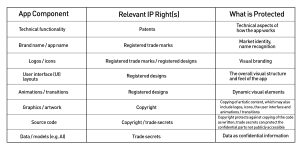
The important takeaway is that no single right protects the entire app. Without a layered approach, competitors may not need to copy everything to compete effectively. For example, reproducing branding, graphics, interfaces, or selected functional features may be enough to capture value while avoiding infringement.
To summarise the above mapping, a recommended layered approach to app protection would involve IP rights as follows:
In many cases, apps will not include functionality that is realistically patentable. This is completely normal and will just increase the relative importance of the other IP rights available.
Failing to adopt a layered approach can leave critical gaps, for example, a competitor may avoid patent infringement while replicating branding or user interface elements, or recreate functionality that is not otherwise protected.
Apps can have an endless variety of properties and functionality, so IP strategy will vary on a case by case basis depending on the particular properties of the app in question. Nonetheless, a general strategy for using the IP toolkit might involve:
As always, a professional should always be consulted to recommend a specific strategy for the app in question.
In an invented example, an AI-based fitness app might be protected in the following ways:
Together, these rights create a much more robust and defensible position than any single right alone.
Protecting an app is not about selecting a single form of intellectual property but about using the available rights in a coordinated way.
The most effective approach will depend on how the app creates value in practice. Taking a structured, early view of IP can significantly strengthen both the protection obtained and long-term commercial outcomes.
This article was written by Senior Associate, Henry Shine. If you would like to discuss this topic or something else, please get in touch at Henry.Shine@wilsongunn.com or contact one of our attorneys for advice.